
Liquid Logic
People move fluidly between languages in Barcelona. It’s natural, but it’s also political.

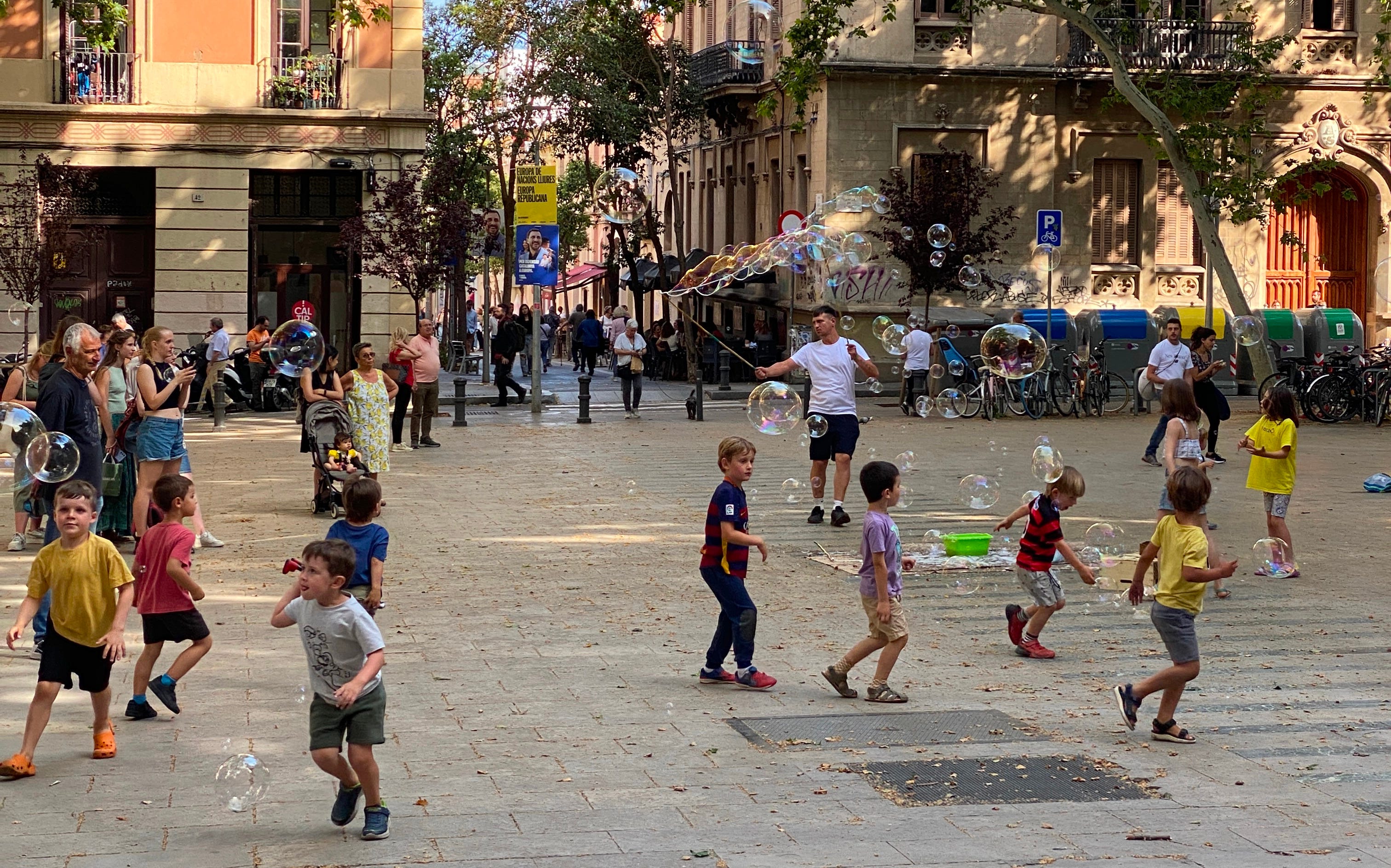
Joaquim is learning three languages. Tiene tres años y medio. He’s three and a half years old. He speaks Catalan with his father and Portuguese with his mother, and while he understands both, he sometimes mixes the two. It’s fluid.
He’s also learning some Castilian, or Spanish, but not directly. He doesn’t speak it with his family or at school, but he’s picking up words and phrases all the same.
A few months ago, I was having dinner with his parents when he decided to speak to me in his limited vocabulary, understanding that it’s the language we share. His father, Adrià, noticed it first.
“He’s trying to speak Spanish with you,” he said.
Adrià is an artist from Barcelona who speaks seven languages, and Lúcia is an artist from Lisbon who speaks four. They are my support network here, and I wanted to help them as much as they’ve helped me, so I offered to babysit.
And just to be safe, I called in a ringer. Débora lives in Los Angeles with her husband and two children. She’s from Barcelona, but she moved to LA as a teenager. In college, we rented a house in Highland Park with a terraced hillside for a backyard. She’s known both Adrià and I for years, and she speaks Catalan among several other languages. Débora and I agreed that if I had any babysitting questions, I’d call her.
The night I babysat, Joaquim and I spoke our own language of juguetes, or toys. We pointed at toys and played, and I picked him up and flew him through the living room before dumping him on the sofa. He tired eventually, and he wanted me to read one of his many books before bed. Adrià had prepped me.
“He’ll want you to tell him a story while you look at pictures,” he said.
I struggled to find the words to invent a story in Spanish while we flipped pages in a book, so Joaquim pointed to a drawing of a star in a night sky. He told me the different words his parents use. “Star” in Catalan is estrella. In Portuguese, it’s estrela. The difference is in the pronunciation, and Joaquim used both languages while I marveled, as I have since I arrived, at how fluid language is here.
In Spain, you’ll find cultural differences everywhere, the result of the patchwork of independent regions that exercise their right to self-government within the limits of the constitution and central government in Madrid.
Those differences include the languages spoken across the country. Spain officially recognizes Spanish as its official language, but several autonomous regions also have officially recognized languages. Aranese is spoken in the Val d'Aran region in the Pyrenees, Basque in the Basque Region, Catalan in Catalonia, and Galician in Galicia. Valencia has a recognized language, but it’s a dialect of Catalan and its designation is highly politicized. Additionally, there are two protected languages spoken in Asturias and one in Aragon.
The Basque language, Euskara, is ancient, the oldest in Europe, and it predates any attempts to define its history. A sort-of mirrored world results. Signage in San Sebastián, for example, often features two names for everything, Euskara and Castilian. After the fall of Franco’s dictatorship in 1975, laws were rewritten in Barcelona so that most signage—street signs, storefronts, everything you see while walking in the city—is in Catalan, but there is a mix of languages on storefronts here that includes Catalan, Spanish, and even English.
Franco’s regime attempted to silence these independent languages. For 36 years, his dictatorship led Spain with a repressive right-wing ideology known as National Catholicism. Catalan, like every other regional language, was forbidden to be spoken or studied. Locals could only speak it behind closed doors, and quietly at that for fear of neighbors listening.
The dictatorship ended with Franco’s death in 1975. He wasn’t removed from office; he stepped down of his own accord and handed leadership of his party to hand-picked successors. A transition to democracy followed under King Juan Carlos I that adopted a constitutional monarchy and a parliamentary system, but one of the country’s two most powerful political parties today, the Partido Popular (PP), was founded by former members of Franco’s regime.
By some estimates, the regime is responsible for the murder of 150,000 people, many of whom are buried in unmarked graves. There have been attempts to address this history. Statues of Franco have been removed from squares across the country. The Valle de los Caídos, a mausoleum outside of Madrid that Franco ordered built by members of the losing side of the Spanish Civil War, served as his tomb until his exhumation in 2019 after a legal battle to remove public celebrations of his dictatorship.
These are small steps, but his legacy still clouds everything. It’s no wonder, then, that the Catalans are so insistent about protecting their cultural heritage, and that begins with their language.
Joaquim will likely speak four languages before he turns ten, and he’ll learn Spanish eventually. After he and I read the book about stars, I called Débora in Los Angeles. Not because I needed to; it sounded fun. She spoke to me in English, and she spoke to Joaquim in Catalan. Her children jumped on the call to say hello in a mix of English and Spanish. Languages flew about our conversation, a natural thing for everyone but me.
Loved this one!